PREVNAR 20 is now free for eligible people 65+
Check-ups
Children
Children ages 1-5 are advised to come for annual check-ups.
After 5 years old, consider an annual check-up every 2-3 years unless there is a chronic health condition in which case, they should be seen annually.
Adult Physicals

ADULT PHYSICALS ARE RECOMMENDED FOR ANYONE 50 + AND THOSE WITH A CHRONIC HEALTH CONDITION
We understand that healthcare can be overwhelming and stressful. Our team of compassionate healthcare professionals is committed to making each patient's visit as comfortable and stress-free as possible.
Blood Testing
Blood tests are ordered based on assessment of health, past medical history and family history. More routine blood screening starts at the age of 50 but can be earlier dependent on risk. Blood testing for Diabetes, High Cholesterol, Liver and Kidney Function are among things commonly screened as well as vitamin levels and appropriate hormone screening.
FIT Testing/Colon Cancer Screening
Men and women between the ages of 50 to 74, with no symptoms, should get screened for colon cancer every two years with the fecal immunochemical test (FIT).
Colonoscopy is recommended every five to 10 years for people with at least one of the following:
-One first degree relative (mother, father, sister, brother, daughter or son) with colon cancer diagnosed under the age of 60 or
-Two or more first degree relatives with colon cancer diagnosed at any age or
-A personal history of adenomas
Follow up colonoscopy recommendations are given after the first screening colonoscopy.
Lung Cancer Screening
For adults aged 55-74 years with at least a 30 pack-year smoking history , who currently smoke or quit less than 15 years ago, the CTFPHC ( Canadian task force on preventative health ) recommends annual screening with low dose CT scan of chest for three consecutive years.
Breast Imaging/Mammography
Screening mammograms are available for women 40 years and older and recommended every two years. See chart beside for more information.
Women are not eligible for a screening mammogram if they:
-Have breast implants (see your doctor to arrange a mammogram).
-Are pregnant or breastfeeding (you can use the breast screening program three months after completely finishing breastfeeding; see your doctor immediately if you experience any new problems).
-Have a previous history of breast cancer.
-Have any new breast complaints such as a lump or nipple discharge (see your doctor immediately if you experience any new problems).
-Have had a mammogram on both breasts in the last 12 months (you must wait at least one year before having another screening mammogram).
Radiologists are now reporting on breast density. Having dense breasts is an independent risk factor for breast cancer and is more common in younger people.
For more information on breast density, and what it means for you visit: https://cancer.ca/en/treatments/tests-and-procedures/mammography/breast-density

Prostate Cancer Screening
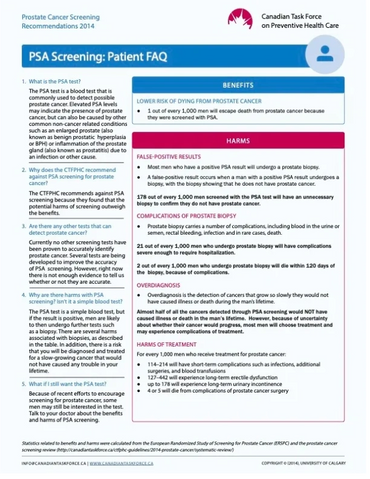
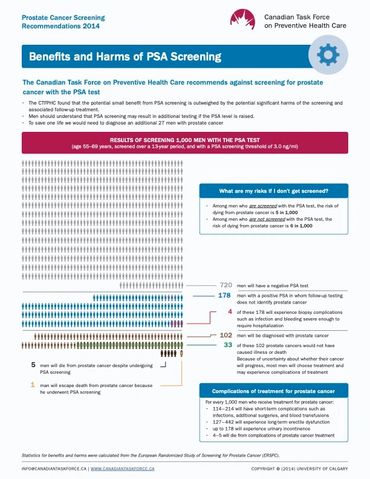
Screening for over 65
Bone Density
Women over age 65 and people with higher risks should consider a bone density exam depending on risk factors which include:
-age over 65
-long term use of corticosteroids
-previous fragility fractures
-a parent with a fractured hip
-a recent hip fracture
-current smoking
-prior Breast CA treatment
-Alcohol Consumption greater than 3 units daily
Younger people who are high risk may also be referred for a bone density exam.
Bone density exams can be repeated every 3 years.
AAA Screening
The CTFPHC recommendation is for one-time screening with ultrasound for abdominal aortic aneurysm for men aged 65 to 80. Women and men over the age of 80 do not need to be screened. Risk factors for those susceptible to AAA includie smoking, advanced age, family history of AAA, Coronary artery disease, atherosclerosis, hypercholesterolemia, and hypertension
